Skyping with my Mum before we left for India she asked, hesitantly
'And how are you planning to get around? Will you be using public transport? Will you be going on.... ' (I could hear the intake of breath) 'buses?'
I assured her I would not.
She wasn't the only one. When I told people where I was going the most frequent reaction was 'be careful' rather than 'how exciting' as it was two years ago. I have to admit, I had a moment of hesitation at the thought of travelling around alone while the DFP was working. A hesitation I didn't even momentarily have the last time I visited. I wandered around completely at ease.
Since the Delhi rape last year it seems as though another horrific rape story comes from India every few weeks. I can't help but think that this must be because they are being reported more and given greater exposure than that there is a greater instance. That alone has made me re-think how I behave as a female traveller in Asia.
I was much more careful in my packing. I made sure to take clothes which covered my chest and upper arms. I wore knee-length leggings underneath dresses. I wore a wedding ring. Nothing says, 'fuck off' like a wedding ring.
It may all sound a bit extreme but it's easy to forget how different the cultural norms are in Asia and how unthinkingly westerners can create a damning reputation for themselves, a reputation which for women can also be dangerous.
When I met the DFP at the airport and gave him a kiss he warned me that it isn't at all done in India. Even holding hands is not normal for a man and a woman. Of course it's completely fine for two men to wander around hand in hand, or one arm drapped around the other, but for a man and a woman to do that? No way.
So I was careful and I was fine. We started our trip in Mumbai. The rains had come early this year and in force. Earlier and wetter than usual we were told.
My ancestors were part of the British colonial empire and one of them has a memorial in St Thomas' cathedral in Mumbai. Here it is.


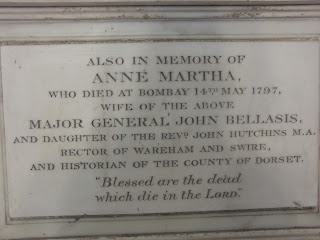
Rather grand eh? His poor wife doesn't get much of a look in though, does she.
The cathedral itself is pure colonialism, recently re-ordered (that's refurbished in church talk to all you heretics) so the walls were bright with fresh, white paint. The overhead fans spinning smoothly. It felt airy and peaceful. A piano tuner who looked like he'd dropped straight from Fulham Broadway was tuning the piano as I wandered around. One of the glass globe light shades had fallen and was lying, almost perfect but with a crack in it's shell like a boiled egg by one of the pillars.
I sat at the back to soak up the atmosphere and check the guide book. (Always walk as though you know where you are going even if you don't, but ideally know where you are going.) As I was sitting there a piece of plaster fell from the perfectly smooth white ceiling directly above me and landed on my head. It was a very surreal.
But this is what happens because India is rife with corruption. The money gets spent bribing whoever is hiring leaving insufficient funds for the actual project. Newly laid roads wash away in the first monsoon rains. Famously the facilities for the recent commonwealth games were shoddy and unfinished and plaster falls from the ceiling of the newly re-ordered church.

From Mumbai we flew to Varansi (three days by train, two hours by plane). It's the Hindu equivalent of Mecca, to be visited at least once in a lifetime by a good Hindu. It huddles on the sides of the river Ganges, rows of higgledy piggledy temples or ghats.


A couple of the ghats are burning ghats. People bring the bodies of their relatives to be burned, purifying them. A man, who assured us with a laugh that he wasn't a guide, (and then asked us for money for the 'up keep of the temple') explained that there are a few types of bodies which don't need purification by burning as they are already considered pure. These are tied to a stone and thrown in the Ganges. The already pure are those under ten, the pregnant, priests and those who have died from leprosy or smallpox. It's also very holy and purifying to swim in the Ganges. Just hold your breath and hope no one has died of leprosy recently.
The guidebook recommended a fort a long rickshaw ride away from where we were staying. On the approach the jumbled streets were lined with buildings which, once upon a time, would have been lofty and beautiful. Now they were crumbling into the hub bub.
The fort itself was rather a let down. Or as the DFP succinctly put it, 'why did you bring me here?' Why indeed? The 'museum' was a random collection of stuff the British couldn't fit in their hand luggage before they left which hadn't been dusted since then either. I particularly enjoyed the labelling. A sword was labelled 'a very big sword'. Thanks for that. Again it had the eerie, dusty ex-splendour of a building slowly rotting into dust.
It was quite busy with Indian tourists. I didn't see that many Western tourists wherever we were. The monsoon had washed them away. Perhaps that's what made the DFP and I seem exotic.
We were sitting on a wall at the fort consulting the unreliable guide book when a large group of Indians came up. They asked us where we were from, shook the DFP's hand and namasted me (note, there is no physical contact assumed with a woman you don't know). There was lots of smiling from both groups. Then they asked if they could take our photo. We were surprised but agreed. They got us to shuffle up so there was a space between us, sat their elderly mother down in the space, took a photo and thanked us profusely. More smiling and namasteing. But that wasn't the end. Another person sat down between us and a photo was taken. And another. And another. And another.
By the time they had finished about eight different people had been photographed with us as though we were an unusually pliant and uncamera shy Angelina Jolie and Brad Pitt. In fact this must be like what it feels like to be super famous because that wasn't the end of the photo taking.
From Varansi we flew to Delhi where I took a day trip to the Taj Mahal, (which is just as good as it's cracked up to be). As I was wandering around I was approached again and again to have my photo taken. Quite a long way into the day I decided that I would take a photo of everyone who had their photo taken with me. It became a lovely exchange and I now have a lot of photos of random Indian people and here they are.


I'm not going to bang on about the Taj Mahal. It's fab. You should definitely go.


I also went to the mini Taj as it's nicknamed. Tomb to someone else. Smaller, less people. In fact lots of locals seemed to be just hanging out there, passing the time of day. A kind of incredibly old, amazingly beautiful behind the bike-shed for locals and their kids.
While I was trying to take photos of the amazing inlaid tiles three small girls kept sidling into my pictures. Initially I tried moving the camera so they weren't in shot. But they continued to move into frame. So I just gave up and took photos of them which made them squeal with delight when I showed them on the digital displayer and demand more, which I took, because I am a big softy. This started a mini avalanche of small and medium sized children demanding to be photographed and delighting in the results.


A lot of the time in India an interaction which seems genuine, like the guy who assured us he wasn't a guide and then asked for money, ends up with someone asking you for money. They have endless time and very little money. The opposite of us. It's understandable, but sometimes feels a bit sad. What was so lovely about all the reciprocal photography around the Taj was that no one at any time asked for money. Just a photo and occasionally a little chat. (Where are you from? You're very beautiful. I like your watch.) While in some ways I don't mind the money, I understand the differences in our finances, but it dehumanises you. You are only a walking money bag. It's lovely that this time it wasn't the case.
I left early for the (five hour) drive to Agra where the Taj Mahal is. A couple of hours in I looked up blearily as we slowed to pass a truck, it's back open, a crowd of men opposite watching. I glimpsed a body, one side ripped open and bloody, blue grey organs bulging out, being lifted into it.
People often say 'life is cheap' in India. Perhaps it's true. You learn to harden your heart to beggars, the children who come and ask for money, because you know they probably won't get it and it exacerbates a problem. We were walking along the road behind a man and a little girl. When the man noticed us he gestured to the girl and then moved away from her. She came up to us and started making kissing noises and holding her hand out to us. If we had given her any money I am sure she wouldn't have got any of it.
But when you see little ones lying on the ground, half dressed, it's almost more than I can do not to go up and scoop them up and hug them and hug them. My heart tears open and I feel so angry and helpless that there's nothing I can do, not even give a little guilt money.
Life is cheap? Perhaps.
We were talking to someone who said her husband works a lot in India but doesn't like it. He had good reason. He had been in the back of a car when the driver hit a family on a scooter. The family were all killed. The driver ran. In India people are dragged from cars and beaten to death in instances like this. A crowd gathered, beating at the car. He and a colleague were in the back. They locked the doors and windows. They didn't know what to do. Luckily another colleague was in a car behind and was able to calm the situation. But their fears were not misplaced. So life is cheap, but valuable too.
This is part of the conundrum of travelling in Asia. Do you shut your eyes? Harden your heart? Do you give money to ease your conscience but which may ultimately do more harm than good? I haven't found a good solution yet, but I feel more and more strongly than ever that I need to find one.
'And how are you planning to get around? Will you be using public transport? Will you be going on.... ' (I could hear the intake of breath) 'buses?'
I assured her I would not.
She wasn't the only one. When I told people where I was going the most frequent reaction was 'be careful' rather than 'how exciting' as it was two years ago. I have to admit, I had a moment of hesitation at the thought of travelling around alone while the DFP was working. A hesitation I didn't even momentarily have the last time I visited. I wandered around completely at ease.
Since the Delhi rape last year it seems as though another horrific rape story comes from India every few weeks. I can't help but think that this must be because they are being reported more and given greater exposure than that there is a greater instance. That alone has made me re-think how I behave as a female traveller in Asia.
I was much more careful in my packing. I made sure to take clothes which covered my chest and upper arms. I wore knee-length leggings underneath dresses. I wore a wedding ring. Nothing says, 'fuck off' like a wedding ring.
It may all sound a bit extreme but it's easy to forget how different the cultural norms are in Asia and how unthinkingly westerners can create a damning reputation for themselves, a reputation which for women can also be dangerous.
When I met the DFP at the airport and gave him a kiss he warned me that it isn't at all done in India. Even holding hands is not normal for a man and a woman. Of course it's completely fine for two men to wander around hand in hand, or one arm drapped around the other, but for a man and a woman to do that? No way.
So I was careful and I was fine. We started our trip in Mumbai. The rains had come early this year and in force. Earlier and wetter than usual we were told.
My ancestors were part of the British colonial empire and one of them has a memorial in St Thomas' cathedral in Mumbai. Here it is.


Rather grand eh? His poor wife doesn't get much of a look in though, does she.
The cathedral itself is pure colonialism, recently re-ordered (that's refurbished in church talk to all you heretics) so the walls were bright with fresh, white paint. The overhead fans spinning smoothly. It felt airy and peaceful. A piano tuner who looked like he'd dropped straight from Fulham Broadway was tuning the piano as I wandered around. One of the glass globe light shades had fallen and was lying, almost perfect but with a crack in it's shell like a boiled egg by one of the pillars.
I sat at the back to soak up the atmosphere and check the guide book. (Always walk as though you know where you are going even if you don't, but ideally know where you are going.) As I was sitting there a piece of plaster fell from the perfectly smooth white ceiling directly above me and landed on my head. It was a very surreal.
But this is what happens because India is rife with corruption. The money gets spent bribing whoever is hiring leaving insufficient funds for the actual project. Newly laid roads wash away in the first monsoon rains. Famously the facilities for the recent commonwealth games were shoddy and unfinished and plaster falls from the ceiling of the newly re-ordered church.

From Mumbai we flew to Varansi (three days by train, two hours by plane). It's the Hindu equivalent of Mecca, to be visited at least once in a lifetime by a good Hindu. It huddles on the sides of the river Ganges, rows of higgledy piggledy temples or ghats.


A couple of the ghats are burning ghats. People bring the bodies of their relatives to be burned, purifying them. A man, who assured us with a laugh that he wasn't a guide, (and then asked us for money for the 'up keep of the temple') explained that there are a few types of bodies which don't need purification by burning as they are already considered pure. These are tied to a stone and thrown in the Ganges. The already pure are those under ten, the pregnant, priests and those who have died from leprosy or smallpox. It's also very holy and purifying to swim in the Ganges. Just hold your breath and hope no one has died of leprosy recently.
The guidebook recommended a fort a long rickshaw ride away from where we were staying. On the approach the jumbled streets were lined with buildings which, once upon a time, would have been lofty and beautiful. Now they were crumbling into the hub bub.
The fort itself was rather a let down. Or as the DFP succinctly put it, 'why did you bring me here?' Why indeed? The 'museum' was a random collection of stuff the British couldn't fit in their hand luggage before they left which hadn't been dusted since then either. I particularly enjoyed the labelling. A sword was labelled 'a very big sword'. Thanks for that. Again it had the eerie, dusty ex-splendour of a building slowly rotting into dust.
It was quite busy with Indian tourists. I didn't see that many Western tourists wherever we were. The monsoon had washed them away. Perhaps that's what made the DFP and I seem exotic.
We were sitting on a wall at the fort consulting the unreliable guide book when a large group of Indians came up. They asked us where we were from, shook the DFP's hand and namasted me (note, there is no physical contact assumed with a woman you don't know). There was lots of smiling from both groups. Then they asked if they could take our photo. We were surprised but agreed. They got us to shuffle up so there was a space between us, sat their elderly mother down in the space, took a photo and thanked us profusely. More smiling and namasteing. But that wasn't the end. Another person sat down between us and a photo was taken. And another. And another. And another.
By the time they had finished about eight different people had been photographed with us as though we were an unusually pliant and uncamera shy Angelina Jolie and Brad Pitt. In fact this must be like what it feels like to be super famous because that wasn't the end of the photo taking.
From Varansi we flew to Delhi where I took a day trip to the Taj Mahal, (which is just as good as it's cracked up to be). As I was wandering around I was approached again and again to have my photo taken. Quite a long way into the day I decided that I would take a photo of everyone who had their photo taken with me. It became a lovely exchange and I now have a lot of photos of random Indian people and here they are.


 |
| Yes, they did get me to hold the baby. |


I also went to the mini Taj as it's nicknamed. Tomb to someone else. Smaller, less people. In fact lots of locals seemed to be just hanging out there, passing the time of day. A kind of incredibly old, amazingly beautiful behind the bike-shed for locals and their kids.
While I was trying to take photos of the amazing inlaid tiles three small girls kept sidling into my pictures. Initially I tried moving the camera so they weren't in shot. But they continued to move into frame. So I just gave up and took photos of them which made them squeal with delight when I showed them on the digital displayer and demand more, which I took, because I am a big softy. This started a mini avalanche of small and medium sized children demanding to be photographed and delighting in the results.
 |
| Photo-bombing. |
 |
| Let your eyes adjust. If you look very, very careful amongst the brightly coloured tiles you might just be able to see a small child. Got her? Well done. |
 |
| Balanced on a precarious ledge. Her sister thought it was hilarious that I was so nervous for her and wanted her to be taken down. |


A lot of the time in India an interaction which seems genuine, like the guy who assured us he wasn't a guide and then asked for money, ends up with someone asking you for money. They have endless time and very little money. The opposite of us. It's understandable, but sometimes feels a bit sad. What was so lovely about all the reciprocal photography around the Taj was that no one at any time asked for money. Just a photo and occasionally a little chat. (Where are you from? You're very beautiful. I like your watch.) While in some ways I don't mind the money, I understand the differences in our finances, but it dehumanises you. You are only a walking money bag. It's lovely that this time it wasn't the case.
I left early for the (five hour) drive to Agra where the Taj Mahal is. A couple of hours in I looked up blearily as we slowed to pass a truck, it's back open, a crowd of men opposite watching. I glimpsed a body, one side ripped open and bloody, blue grey organs bulging out, being lifted into it.
People often say 'life is cheap' in India. Perhaps it's true. You learn to harden your heart to beggars, the children who come and ask for money, because you know they probably won't get it and it exacerbates a problem. We were walking along the road behind a man and a little girl. When the man noticed us he gestured to the girl and then moved away from her. She came up to us and started making kissing noises and holding her hand out to us. If we had given her any money I am sure she wouldn't have got any of it.
But when you see little ones lying on the ground, half dressed, it's almost more than I can do not to go up and scoop them up and hug them and hug them. My heart tears open and I feel so angry and helpless that there's nothing I can do, not even give a little guilt money.
Life is cheap? Perhaps.
We were talking to someone who said her husband works a lot in India but doesn't like it. He had good reason. He had been in the back of a car when the driver hit a family on a scooter. The family were all killed. The driver ran. In India people are dragged from cars and beaten to death in instances like this. A crowd gathered, beating at the car. He and a colleague were in the back. They locked the doors and windows. They didn't know what to do. Luckily another colleague was in a car behind and was able to calm the situation. But their fears were not misplaced. So life is cheap, but valuable too.
This is part of the conundrum of travelling in Asia. Do you shut your eyes? Harden your heart? Do you give money to ease your conscience but which may ultimately do more harm than good? I haven't found a good solution yet, but I feel more and more strongly than ever that I need to find one.


